
Painful joint replacement assessment
Persistent or new pain after hip or knee replacement deserves a structured assessment. The aim is to identify the cause of the symptoms and determine whether revision surgery, non-surgical treatment or further investigation is most appropriate.
Pain after joint replacement has more than one possible cause
- Loosening, wear, instability, fracture and infection can cause symptoms
- Some pain may come from tissues around the joint or another part of the body
- Previous X-rays and implant details can be particularly useful
- Revision surgery is considered only when there is an identifiable problem it is likely to improve
Why can a replaced joint become painful?
A hip or knee replacement can work well for many years, but some patients develop persistent pain, new pain, stiffness, swelling, instability or loss of function.
The presence of pain does not automatically mean that the artificial joint is loose or needs replacing. Symptoms can arise from several different causes, including the implant itself, the surrounding bone and soft tissues, infection, fracture or a problem elsewhere that is being felt around the replaced joint.
A structured assessment aims to move from the symptom - pain - to the diagnosis and then to the most appropriate treatment pathway. That usually involves understanding how the symptoms developed, examining the joint, reviewing imaging and arranging further investigations where they are likely to influence treatment.
For some patients the assessment identifies a clear problem that can be addressed with revision surgery. For others, revision is unlikely to help and a different treatment pathway is more appropriate.
The value of specialist assessment is in establishing whether there is an identifiable cause that can reasonably be treated, rather than assuming further surgery is required.

Assessment is about finding an explanation, not assuming implant failure
Comparison with previous X-rays, implant information and the pattern of symptoms can help identify loosening, wear, instability, fracture or other structural change. Further tests are used only when they are likely to answer a specific clinical question.
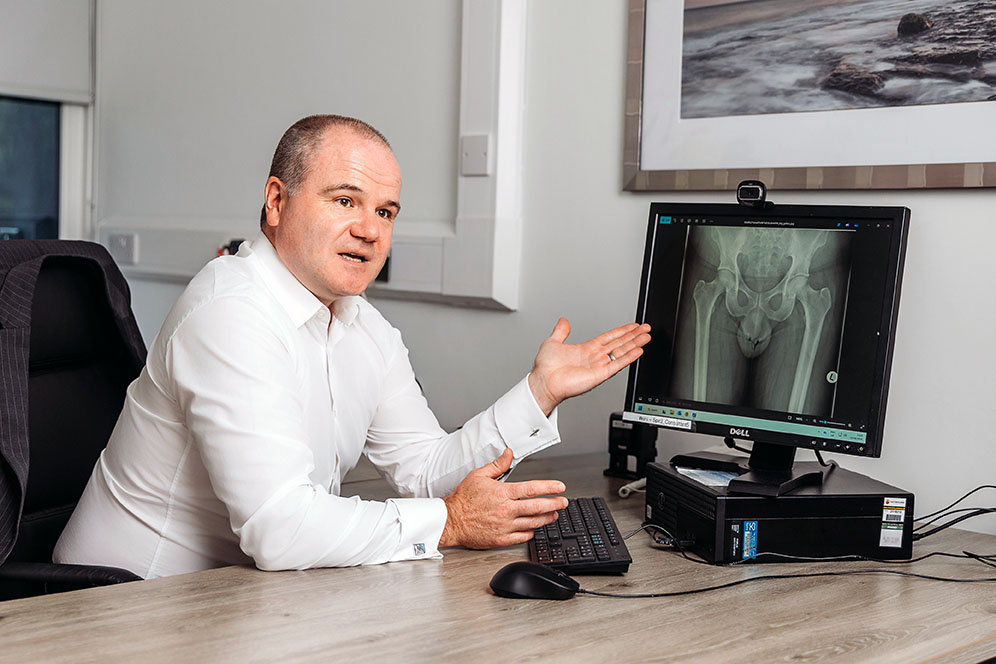
Not every painful replacement needs another operation
The aim is to identify whether there is a problem that revision surgery is likely to improve. When there is not, rehabilitation, pain management, further investigation or treatment of another source of symptoms may be more appropriate.
Problems that may need to be considered
The pattern of symptoms and the type of joint replacement help guide investigation. More than one factor can sometimes contribute.
Implant loosening
A component can lose secure fixation to the bone, causing pain and sometimes progressive bone loss or instability.
Implant wear
Artificial components can wear over time. Wear may contribute to pain, reduced function and changes in the surrounding bone.
Instability or dislocation
A replaced joint may feel unstable, give way or, in the hip, dislocate. The reason for instability needs to be identified before treatment is planned.
Joint replacement infection
Infection around an artificial joint can cause pain and implant loosening and may occur even without dramatic external signs.
Fracture or bone loss
Fracture around a replacement or progressive loss of supporting bone can cause pain and may affect implant stability.
Soft tissue or referred pain
Tendons, muscles, the back and other nearby structures can sometimes produce pain around a replaced hip or knee even when the implant itself is stable.
Building a complete picture of the joint replacement
Assessment starts with the history of the original joint replacement and the symptoms that have developed since. The timing and character of pain, swelling, stiffness, instability, wound problems, previous infections and any injury are all relevant.
Examination considers movement, tenderness, swelling, stability, walking pattern and possible causes outside the replaced joint. Existing X-rays are reviewed wherever possible, and comparison with earlier images can be especially informative.
Information worth bringing
- Previous operation letters or discharge summaries
- Implant details if available
- Recent and older X-rays or scans
- Records of any previous infection or wound problem
- A list of current medicines and relevant medical history
Further tests may include
- Updated weight-bearing X-rays
- CT or other specialist imaging where useful
- Blood tests when infection is a possibility
- Joint aspiration in selected cases
- Other investigations guided by the suspected cause
Sudden severe pain after a fall or injury, a visibly deformed joint, inability to bear weight, or a suspected dislocation also requires urgent assessment rather than a routine outpatient appointment.
From symptoms to a treatment plan
Understand the symptoms
The consultation explores when the joint replacement was performed, how it initially recovered and when the current symptoms began.
Review the replacement
Examination and imaging assess implant position, fixation, alignment, bone, joint stability and other possible sources of pain.
Investigate specific concerns
Blood tests, advanced imaging or joint aspiration may be used when needed to investigate infection, bone loss, component position or another suspected cause.
Agree the next step
The findings are used to discuss observation, rehabilitation, another non-surgical treatment, further investigation or revision surgery where there is a clear indication.
Assessment does not automatically lead to surgery
A useful assessment should clarify what is known, what remains uncertain and whether there is a treatment likely to improve the problem.
Non-surgical management
If the implant is stable and there is no surgically correctable problem, rehabilitation, pain management or treatment of another source of symptoms may be recommended.
Further investigation
Some cases require additional imaging, blood tests, aspiration or review of previous records before a confident diagnosis and treatment plan can be made.
Revision surgery
When assessment identifies loosening, infection, instability, fracture or another problem that revision is likely to improve, reconstruction can be planned in detail.
Questions about painful joint replacements
Does pain mean my hip or knee replacement is loose?
No. Loosening is one possible cause, but pain may also relate to infection, instability, fracture, surrounding soft tissues or a source outside the replaced joint. Imaging and clinical assessment are needed to distinguish between them.
Can a joint replacement become infected years after surgery?
Yes. Deep infection can occasionally develop well after the original operation. Where infection is suspected, specific investigations are required before deciding on treatment.
Will I need a scan?
X-rays are usually the starting point. CT or another type of imaging may be requested when the result would help answer a specific question about component position, bone or another potential cause of symptoms.
What is a joint aspiration?
A joint aspiration involves taking a sample of fluid from around the artificial joint using a needle. It may be recommended when infection or another condition needs further investigation.
What if no clear cause is found?
Revision surgery is not usually recommended simply for unexplained pain when there is no identifiable problem it is expected to correct. The next step may instead involve observation, rehabilitation, pain management or further investigation.
Get a painful hip or knee replacement properly assessed
A consultation with Mr Dowen can review your previous operation, symptoms and imaging, investigate why the replacement is painful and explain whether further treatment or revision surgery is likely to help.