
Meniscal tear
A meniscal tear can follow a twisting injury or develop gradually as the meniscal changes over time. Symptoms may include pain, swelling, stiffness, catching or difficulty fully straightening the knee.
Not every meniscal tear needs surgery
- Tears can be traumatic or degenerative
- Pain is often felt around the knee joint line
- Swelling, catching or locking can occur
- Many tears can initially be managed with rehabilitation and activity modification
What is a meniscal tear?
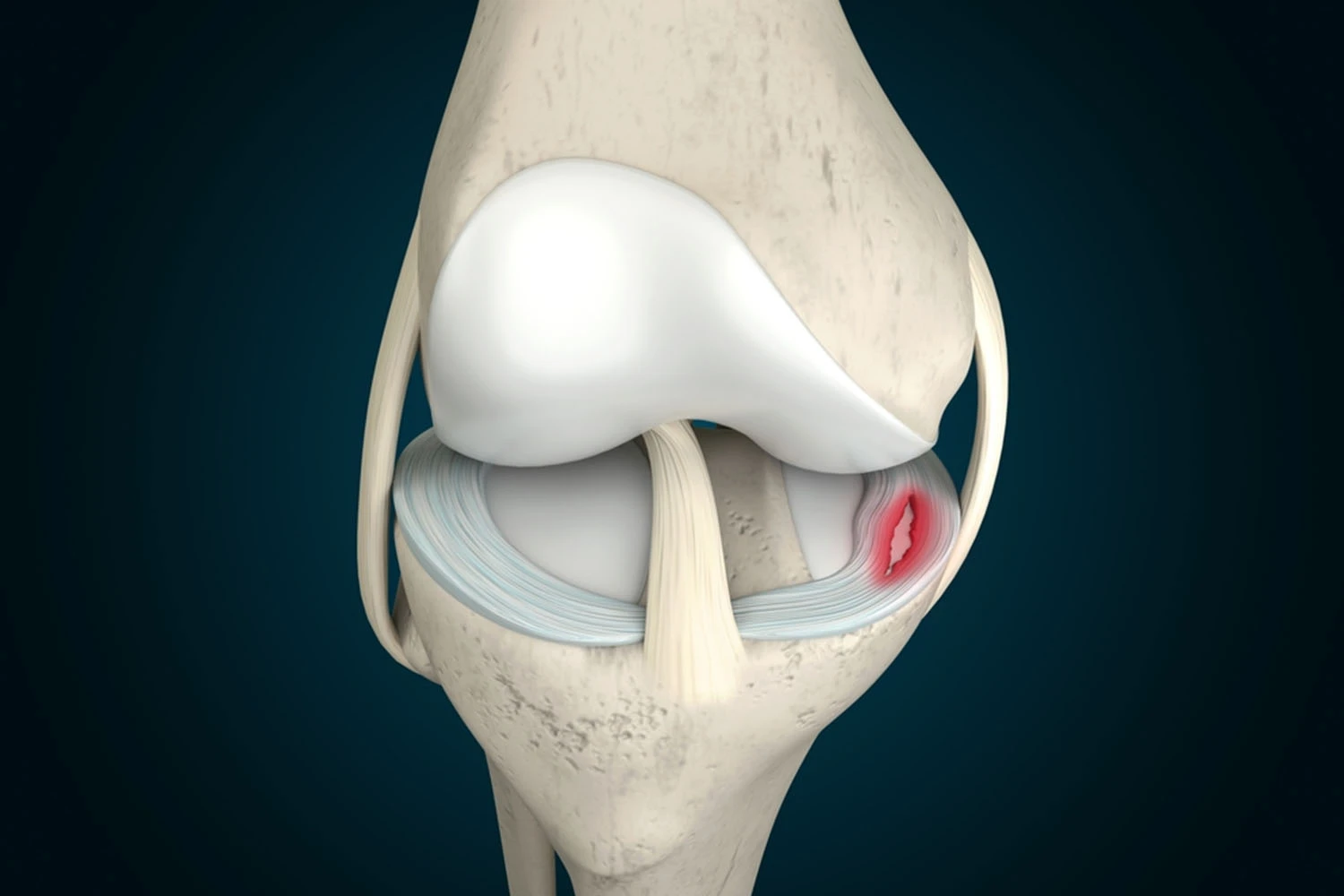
The menisci are two crescent-shaped pads of fibrocartilage within the knee. They help distribute load, absorb shock and contribute to joint stability.
A tear can occur suddenly, often during a twisting movement when the foot is planted, or it can develop gradually as the meniscus becomes less resilient with age. Degenerative tears are common and may exist alongside knee osteoarthritis.
The significance of a tear depends on its pattern, location, the condition of the rest of the knee and the symptoms it is causing. An MRI finding by itself does not necessarily mean that surgery is required.
Meniscal changes are commonly seen on imaging, particularly as people get older. Treatment should therefore be based on the clinical picture rather than an MRI report alone.
Common symptoms of a meniscal tear
Symptoms vary considerably. Some tears produce persistent pain and swelling, while others cause little or no difficulty.
Symptoms you may notice
- Pain along the inside or outside joint line
- Swelling after injury or activity
- Stiffness and reduced movement
- Sharp pain with twisting or pivoting
- Clicking or catching sensations
- Difficulty fully straightening the knee
- Occasional giving way
Mechanical symptoms
A larger or displaced tear may interfere with movement more directly.
- Repeated catching during movement
- A sensation of something moving inside the knee
- Intermittent locking
- Inability to fully straighten the knee
- A knee that becomes stuck in a bent position
Pain, swelling and mechanical symptoms can vary
Meniscal tears do not all behave in the same way. Some mainly cause pain and swelling, while displaced tears can interfere with movement and occasionally cause true mechanical locking.
An MRI finding is only part of the clinical picture
Meniscal changes are common on scans, particularly with age. The history, examination, symptoms and condition of the rest of the knee help determine whether imaging or surgery is likely to be useful.
Different types of meniscal problem
Meniscal tears are broadly associated with acute injury or gradual degenerative change, but there are several tear patterns and clinical presentations.
Traumatic tear
A sudden twist or pivot can tear otherwise healthy meniscal tissue, particularly during sport or other weight-bearing activity.
Age-related meniscal tear
Gradual changes in the meniscal tissue can lead to tearing with relatively minor movements and may occur alongside osteoarthritis.
Mechanical blockage
Some tear patterns can displace into the joint and mechanically restrict movement, sometimes causing true locking.
Medial meniscus
The medial meniscus sits on the inner side of the knee and is a common site of both traumatic and degenerative injury.
Lateral meniscus
Tears of the lateral meniscus affect the outer side of the knee and can occur with twisting injuries or alongside ligament damage.
Combined knee injury
Meniscal tears may occur alongside ligament injuries, cartilage damage or other structural problems within the knee.
When should a meniscal injury be assessed?
Assessment is sensible when pain, swelling or mechanical symptoms are persistent, particularly after a twisting injury or when symptoms are limiting normal activity.
- Pain is not settling with initial self-care
- The knee repeatedly swells
- You cannot return to normal walking or activity
- The knee repeatedly catches or gives way
- You cannot fully straighten the knee
Urgent medical advice is also appropriate for a hot, swollen knee with fever or feeling significantly unwell.
How a meniscal tear is assessed
Diagnosis begins with the history of the injury or symptoms and a clinical examination of the knee.
- Discussion of how symptoms began
- Assessment of swelling and range of movement
- Examination for joint-line tenderness and mechanical signs
- Assessment for associated ligament injury
- Review of X-rays where arthritis or another bony problem is suspected
- MRI when the result is likely to clarify the diagnosis or influence treatment
MRI is useful in selected cases, but not every patient with suspected meniscal pain needs a scan before starting treatment.
Treatment depends on the tear and the symptoms it is causing
Many meniscal tears improve without surgery. Treatment is influenced by whether the tear is traumatic or degenerative, the presence of locking or instability, and the condition of the rest of the knee.
Rehabilitation and activity modification
A period of relative rest followed by progressive strengthening, movement work and physiotherapy is appropriate for many meniscal injuries.
Meniscus repair
Selected tears may be suitable for arthroscopic repair, particularly when the tear pattern and blood supply give the meniscus a reasonable chance of healing.
Explore meniscus repairPartial meniscectomy
Removing an unstable torn fragment may occasionally be considered when a tear cannot be repaired and symptoms remain significant, particularly where there are persistent mechanical symptoms.
What can help after a meniscal injury?
In the first few days after an acute injury, reducing aggravating activity can help pain and swelling settle. Movement can then be gradually restored as comfort allows.
The aim is not prolonged complete rest, but sensible protection followed by progressive rehabilitation.
- Pause sport or activities that repeatedly provoke pain
- Use ice for short periods if it helps swelling
- Elevate the leg when swollen
- Gradually restore comfortable knee movement
- Build thigh and hip strength as symptoms allow
- Avoid repeated deep twisting or pivoting while the knee is irritable
Questions about meniscal tears
Can a meniscal tear heal without surgery?
Yes. Many meniscal injuries improve with time, activity modification and rehabilitation. Whether a tear can biologically heal depends partly on its location and blood supply, but symptoms can improve even when the tear remains visible on imaging.
Does every meniscal tear need an MRI?
No. Clinical assessment is often enough to begin treatment. MRI is generally most useful when the diagnosis is uncertain, significant mechanical symptoms are present or the result would affect decisions about surgery.
What does a locked knee mean?
True locking means the knee becomes mechanically stuck and cannot fully straighten. A displaced meniscal tear is one possible cause and urgent orthopaedic assessment may be required.
Is surgery always needed for a traumatic tear?
No. Some traumatic tears can be treated without surgery. The decision depends on the tear pattern, symptoms, associated injuries, age, activity demands and whether the knee is mechanically blocked.
Why might a surgeon repair rather than remove the meniscus?
Preserving meniscal tissue is desirable where possible because the meniscus contributes to load distribution and knee function. Repair is therefore considered when the tear pattern and tissue quality make healing realistic.
Get persistent meniscal symptoms properly assessed
A consultation with Mr Dowen can review the history of the injury, examine the knee, assess existing imaging and discuss whether rehabilitation or surgical treatment is most appropriate.